Implementation
I rarely replace a client’s marketing team. I work alongside your marketers and agency to get the blueprint into your advertising and marketing. When you need more hands, I bring in partners who already work this way.
Message-first marketing strategy
Most marketing fails for one of two reasons. Either the product isn’t good enough, or the message isn’t. If people buy once they hear you explain it yourself, the product is fine. Your marketing is telling the wrong story.
Zeggio works with founders and leadership teams to write that message down, in eight hours of facilitated sessions, so your team and your agency have something worth building on.
Why marketing misfires
Years ago, a guest from Ukraine stayed with my family and told us jokes in broken English. Plenty of them were funny. The punch lines arrived late and he mangled the grammar, and we laughed anyway. A few never got a laugh. They depended on Ukrainian idioms, and no translator could have rescued them. The problem was the joke didn’t work in our context.
Marketing works the same way. Agencies and marketers are translators. They take what you tell them about your customers, your product, and why anyone should care, and they turn it into ads, web pages, and sales decks. A good translator makes a strong message sing. But even a great translator can’t turn a weak message into something that persuades.
I learned this inside ad agencies. I watched the same writers and designers produce campaigns that took off and campaigns that crashed. The people, the effort, and the fees didn’t change. The difference was what the client walked in with. Clients who knew exactly who their customer was and why they bought gave us something to work with, and we found the breakthroughs. With the rest, we were searching a dark room without knowing how big it was or what we were looking for.
So I’ve spent my career on the part that comes first, getting the message right before anyone writes an ad.
Where it shows up
A message problem doesn’t announce itself. It shows up as bad leads, flat sales, or a campaign that stopped working, and it’s easy to blame the channel, the agency, or the market. Pick the one that sounds familiar.
Your marketing gets attention but doesn’t persuade. Prospects see a list of features and no explanation of why your approach works where others haven’t, so they stay skeptical.
Where the blueprint fixes it Selling claims · Positioning
The hook is attracting people, just not the right ones. Your ads describe a problem your best customers don’t think they have, in words they’d never use.
Where the blueprint fixes it Customer psychology
There’s no offer, or the only offer is the biggest ask you have. That’s proposing marriage on a first date. People still researching need a smaller next step.
Where the blueprint fixes it Offer
Your message is tuned to the few people already shopping for what you sell. Most of your market isn’t shopping yet. They need to recognize the problem before they’ll care about your solution.
Where the blueprint fixes it Customer psychology · Core stories
Audiences tune out after enough repeats, and there’s nothing underneath to make fresh versions from. A handful of written-down core stories can feed hundreds of ads without repeating.
Where the blueprint fixes it Core stories
The message lives in your head. Every new hire, agency, and freelancer has to reinvent it.
Where the blueprint fixes it The written blueprint
You’re using the same words as everyone else in your category, and words like partnership, quality, and service stopped meaning anything years ago.
Where the blueprint fixes it Competition · Brand character
Most of the time, each of these traces back to something your marketers were never given.
Why nobody fixes it
You’d expect someone you hired to catch this. Usually nobody does, and skill has nothing to do with it. The work falls between the roles.
This isn’t a knock on anyone you’ve hired. They’re just not trained to recognize and fix the underlying message problem.
For most of advertising history, the hard part was getting a slogan you could fit in a 30-second ad in front of the right people at a price that left a profit. Today, anyone with $5 can target an audience more precisely than a Fortune 500 company could a generation ago. Reaching customers is cheap now. What you say when you reach them decides whether they buy, and most marketing strategy still treats it as a creative problem to solve project by project.
A case in point
A B2B technology company I worked with hired one of the best-known strategy firms in Silicon Valley to launch a new technology. The firm was brilliant. It interviewed customers, ran surveys, mapped the competition, and wrote a positioning statement that made sense by every traditional rule.
Years after the launch, deals were still stuck in the pipeline. When I asked several dozen employees, from executives to the front line, what the company did, I got dramatically different answers.
We rebuilt the message and rewrote the sales presentation and call scripts. Over the next five months, several stalled deals closed and outbound calling produced more leads. The sample is too small to credit the message alone. But the team noticed right away how much easier it had become to explain what they did and why it mattered.
The Core Message Blueprint
The answers were inside that company the whole time. They usually are. You know more about your customers and your market than any agency ever will. The Core Message Blueprint gets that knowledge out of your head and into a form your marketers can use. It’s built from the six sides of the hexagon.
You end up with a working hypothesis for growth, specific enough for your team to execute and built so you can measure and improve it.
How it works
30 minutes to talk through your goals and whether this is a fit. If it isn’t, I’ll say so.
Several remote sessions with your leadership team and the people who talk to customers every day, usually sales and customer service. In-person is possible. You and your team supply the insights. I ask the questions, and afterward I do the writing.
You get the written Core Message Blueprint and a review of your current marketing, with fixes in priority order so the ones that matter most come first.
What you get
After the blueprint
I rarely replace a client’s marketing team. I work alongside your marketers and agency to get the blueprint into your advertising and marketing. When you need more hands, I bring in partners who already work this way.
Growing companies need CMO-level judgment more than established ones do, and they can rarely justify a full-time CMO’s cost. For select clients, I fill that seat part-time.
Results
3×
sales pipeline within a few months, without more ad spend
B2B SaaS startup
20%
higher conversion rates, adding eight figures in revenue from the same advertising
Consumer health product
#1
most recognized brand in its category, while outspent at least 10:1
Building-products launch
7×
new patient leads, from one or two a week to one or two a day
Natural health practice
Every business is different, and I can’t promise you’ll see the same results.
The book
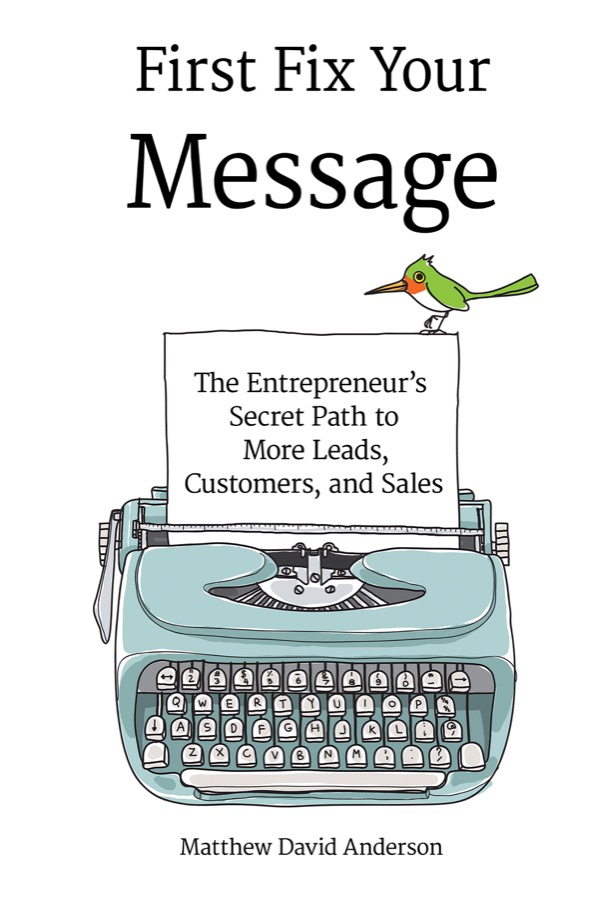
The whole approach, written for entrepreneurs and for the sales leaders who end up running marketing. Read Chapter 4, “Why You (Usually) Can’t Hire a Messaging Solution,” free.
Questions
Some can, and the best would welcome the help. Most agencies do their best work expressing a message, and none of them know your customers the way you do. Neither do I, at the start. The sessions get that knowledge out of you and your team. The blueprint then gives your agency a far better brief, so its work improves and usually takes fewer billable hours.
Most brand guides cover the logo, colors, and fonts. Few say what problem you solve, why customers should believe you, or which stories to tell. The blueprint covers those.
Keep it. It usually feeds the competition and positioning sides of the blueprint. Positioning on its own usually leaves out customer psychology, the offer, and the stories that do the persuading.
About eight hours, spread over several remote sessions. I do the writing between and after them.
No. I work with the people you have, and bring in partners only where there’s a gap.
No. CMOs and marketing directors use it to give their teams and agencies a clear brief. CROs and sales leaders who own marketing get just as much from it, especially at B2B companies where sales drives customer acquisition.
30 minutes by video. We’ll talk through what’s working, where it breaks down, and whether working together makes sense.
Nobody has asked you the right questions yet. Let’s find out what’s missing.